
 Features
Exploring Dynamic and Diffuse Light

Bill Browning
This essay is an expanded version of a LinkedIn article that Bill posted on July 1, 2026.
Dynamic and Diffuse Light is one of the 14 Patterns of Biophilic Design that sometimes gets overlooked. This may be due to people thinking that the pattern is just focused on bringing daylight into a space. Daylight is dynamic and it can be diffuse, and we know that it can elicit strong beneficial psychological and physiological responses. A beam of sunlight can add sparkle to a space and elevate our moods. The changing color balance of sunlight over the course of the day helps regulate our circadian rhythms, in particular the balance between serotonin and melatonin. The patterns of light and shadows under a tree can form a mid-range complexity statistical fractal that has a calming effect.
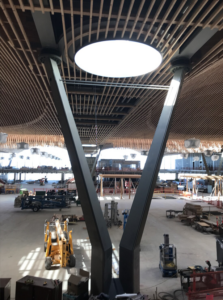
Characteristics of the skylights at PDX International Airport vary depending on what they’re lighting below. Photo by Bill Browning.
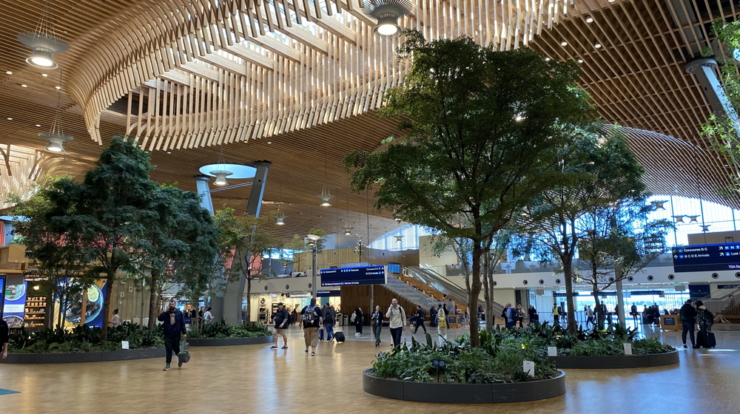
Daylighting a 400,000-square-foot space is a challenge that was embraced by ZGF Architects. The giant wood roof of Portland International Airport (PDX) has 49 skylights, and they are not all the same. The skylights have varying shapes, sizes and levels of transparency depending on what they are lighting.
The giant oval skylight over the forested seam space has clear glazing and a wood lattice rim that provides daylight for the trees below and creates a dappled light pattern on the wooden floor. The circular skylights between the branches of the Y-shaped steel columns create a punch of light that highlights the structure. The skylights over the ticketing and bag check areas have a glazing that produces the soft light of a rainy day in Portland, and prevents glare from interfering with the teams working the counters.
Daylighting is a really important topic, and deserves to be a major focus, but let’s explore three examples of Dynamic and Diffuse Light using electrically generated light.
Westin Gen 5 room prototype
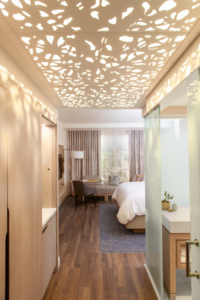
Dynamic lighting feature at the entry of the Westin Gen5 room prototype. Photo courtesy of Marriott.
Westin is one of Marriott’s hotel brands, and it is a business-class hotel that has long been known for their incredibly comfortable ‘Heavenly Bed’. The decision was made to reposition the brand to focus on well-being for business travelers, so more than just the Heavenly Bed, why not a heavenly room? In the process, Marriott designers used the 14 Patterns of Biophilic Design as the source for redesigning their lobbies. When it came time to redesign the guest room experience, branding guru David Kepron reached out to Terrapin to explore biophilic design strategies. One area of focus was design elements that would lower guests’ stress levels, and this involved using Dynamic and Diffuse Light.
The Westin Gen 5 room prototype features a perforated overhead panel in the ceiling of the entry to the room. This panel creates a light pattern on the ceiling, adjoining wall and floor that looks like the calming dappled sunlight under trees. Just opening the door and stepping into the room foyer can lower stress. The prototype room can also include a suspended pendant lamp near the head of the bed. This perforated light fixture casts a complex and compelling light pattern on the wall beside the bed.
Spectral matching with nature
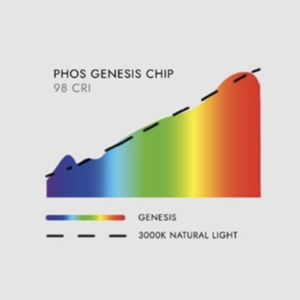
Spectral distribution of Phos Genesis Light Engine mirrors that of natural light. Photo courtesy of Phos.
It is possible to design elegant architectural lighting fixtures that provide lighting that mimics daylight. This is an area of focus for Phos, a 140-year-old family-owned company in the UK. With an engineering and manufacturing background, Phos makes a variety of architectural lighting products. Of note is the Genisis light engine, a proprietary LED chip that, when tied with a specific phosphor, achieves a spectral match that is within 6% deviation from natural daylight across nearly 99 color reference values and has a CRI of 98 (Color Rendering Index).
In effect, the Genisis light engine recreates the true spectral distribution of colors within visible sunlight. Phos has also created a tunable version of their LED for circadian lighting systems.
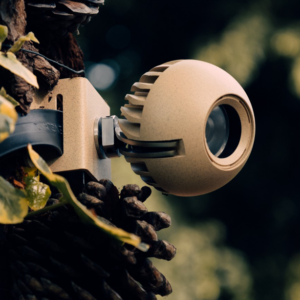
A Phos Orba fixture. Photo courtesy of Phos.
There are few things as dramatic as a tight beam of sunlight in dark space. Some Phos fixtures have precise optics that can create spotlighting replicating that effect. Some of the fixture designs also draw on biomorphic and neuroaesthetic principles, incorporating organic forms and fractal-inspired geometries that echo patterns commonly found in nature.
Xander Cadisch, one of the family members, has become a passionate advocate for biophilia, and the role that light plays in creating healthy beautiful spaces. He leads workshops on biophilic lighting strategies and has written a book on the topic.
Tunable artificial skylights
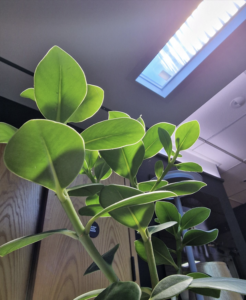
A Z-Window 1503 artificial skylight. Photo courtesy of Kazzar Lighting & Controls.
Taking the idea of artificial daylight a step further, Kam Dhatt and his team at Kazzar Lighting & Controls offer a tunable-white artificial skylight combining a blue-sky aperture with a directional beam of light that creates natural highlights and shadows across plants and architectural surfaces.
The team is also developing a privacy-glass artificial window that uses simple technologies to create depth and impressions like the sunlight coming through the leaves on trees and replicate a dappled sunlight pattern, while embracing advances in spectral LED lighting, including the emerging potential for infrared and near-infrared light.
‘Anatomically correct’ lighting
The light fixture itself can also be a biophilic element in a space. Louis Comfort Tiffany’s design team was rightly famous for creating lamps, like the Wisteria table lamp, that mimicked the form, patterns and colors of nature. Today Milan-based designer, Grinko has translated his passion for anatomy and biomorphic forms from fashion designs into lighting.
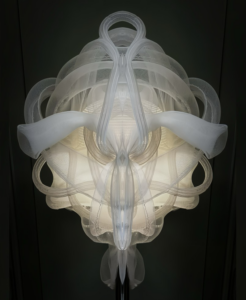
Anatomically Correct light designed by Grinko Illuminati. Photo courtesy of Grinko.
Grinko has a degree in sustainable fashion and has produced designs for the runways of Milan. That work led to interesting explorations of materials and forms. Using nylon fiber optics, bamboo and recycled components he has created lamps that are both biomorphic and deeply intriguing.
‘Anatomically Correct’ uses white fiber shaped into a form inspired by that of a heart, while the ‘Black Iris’ abstracts a bearded iris in black fiber. From some angles the lamps mimic their natural inspirations and from others they seem to become comb jellies or other sea life. The LED lights within are visible from some angles and create a diffuse glow from others. They can be used as floor lamps or suspended chandeliers, and represent a decidedly different take on biophilic lighting.
As with many of the 14 Patterns of Biophilic Design, there are many compelling ways to implement Dynamic & Diffuse Light. Follow the links below to learn more about these examples:
14 Patterns | FlyPDX | PDX by ZGF | Phos Products | Phos Light Tribe | Kazzar Circadian Lighting Products | Grinko Illuminati

Topics
- Conference
- inspirational hero
- interior design
- connection with natural materials
- Carbon Strategy
- Transit
- Mass Timber
- Workshop
- Education
- Psychoacoustics
- biophilia
- Environmental Values
- Occupant Comfort
- Publications
- Portuguese
- French
- Hebrew
- Spanish
- Catie Ryan
- Biophilic Design Interactive
- Biomorphic Forms
- PDX
- 14 Patterns
- Dynamic Light
- Mind-Body-Space
- Epigenetics
- Neuroarchitecture
- collaboration
- fractal fluency
- fractals
- Technology
- Refuge
- Prospect
- Antoni Gaudi
- Awe
- Frank Lloyd Wright
- case studies
- wood
- Sustainability
- economics of biophilia
- Green Guidelines
- Master Planning
- Residential
- Biodiversity
- Systems Integration
- Building Performance
- Indoor Environmental Quality
- Health & Wellbeing
- Climate Resiliency
- Profitability
- Architects and Designers
- Ecosystem Science
- Institutional
- Corporations and Institutions
- Water Management
- Energy Utilization
- Resorts & Hospitality
- Net Zero
- Commercial
- Biophilic Design
- Sustainability Plans
- Greenbuild
- Community Development
- Phoebe
- Terrapin Team
- LEED
- Speaking
- Materials Science
- Carbon Neutrality
- Health Care
- Bioinspired Innovation
- Resource Management
- Industrial Ecology
- Manufacturing
- Original Research
- Product Development
- Urban Design
- Governments and NGOs
- Developers and Building Owners