
 Features
RESEARCH SPOTLIGHT: Fractal Fluency | Richard Taylor, University of Oregon

Terrapin Bright Green
Complexity and Order, as one of the 14 Patterns of Biophilic Design, is an analogue experience of nature. It deals with the finding the balance between a lackluster environment and an overstimulating one. Within nature, fractals are nested, mathematical patterns repeating at increasingly fine size-scales—consider tree branches, capillary riverbeds, fire flames, and crashing waves. These are called statical fractals and occur so frequently in nature that our brains seem to be most attuned to them, what’s referred to as fractal fluency.
Our friend Prof. Richard Taylor and his team at the University of Oregon are the researchers who documented the fractal fluency response, and they continue to expand our understanding of human response to statistical fractals.
Richard’s research spans from fractal retinal Implants to fractals in nanoelectronics, neural sensors and solar cells, and in psychology and art. He’s documented how viewing fractals towards the midrange of complexity seem to lower stress, which can be measured through galvanic skin response and other techniques. Very low complexity can be perceived as dull or boring, while very complex, spikey fractals can be overstimulating or even fear inducing. The new research indicates that viewing fractals that fall between those levels of complexity can lead to higher levels of interest and engagement.
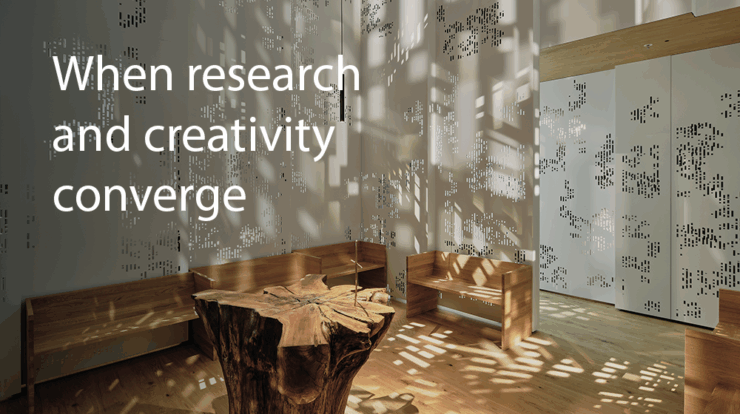
But it’s not always about finding a singular, most fitting dimension—as we consider who we’re designing for and how the space may be programmed, the fractal patterns can be tuned to optimize the experience. Indeed! There are nuances to how we apply science to design so that fractal patterning supports mood, attention restoration, stress recovery or a combination thereof. Consider that the ambiance for a lively bar will naturally be different than for a classy restaurant, but what if you want to be able to shift from offering one experience to another in the same space? An application like this can be found at the Mosh Bar&Dinner in Bucharest designed by INNOCAD and 13&9 Design with consultation from Richard. Backlit ceiling panels patterned with statical fractal perforations can be adjusted to change the fractal dimension of the light patterns in the space thereby shifting the mood from calming to engaging—a clear innovation in biophilic design application and impact potential. Richard’s research has inspired other highly biophilic spaces, products and research.
Notable projects and products using Richard Taylor’s fractals research have been honored with numerous international awards.
- Mosh Bar&Dinner, Romania (url)
- Fractal Chapel, Austria (url)
- Palliative Care Unit, Austria (url)
- Mohawk Group, Relaxing Floors (url)
- Momentum Textiles and Wall Covering, Renaturation Collection (url)
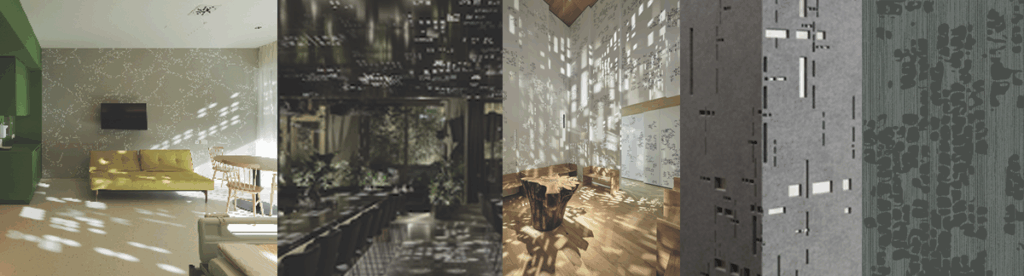
Projects and products developed in collaboration with Prof. Richard Taylor. Photos courtesy Paul Ott, Mohawk Group, and Momentum. Textiles)
Research Publications
- Fractal complexity in visual nature: Perceptual preferences of leaf silhouettes and implications for biophilic design by Amari Davison, Sara Barron, Amy Blood, and Richard Taylor, in Trees, Forests and People (vol. 22, 2025).
- Fractals in architecture: The visual interest, preference, and mood response to projected fractal light patterns in interior spaces by Belal Abboushi, Ihab Elzeyadi, Richard Taylor, and Margaret Sereno in Journal of Environmental Psychology (vol. 61, 2019).
- A Guide to Fractal Fluency: Designing Biophilic Art and Architecture to Promote Occupants’ Health and Performance. Chapter by Richard P. Taylor, Anastasija Lesjak & Martin Lesjak, in The Handbook of Neuroscience and the Built Environment, Alexandros A. Lavdas, Ann Sussman, A. Woodworth, eds. (2026). Routledge, London.
Additional Resources
- What’s Next in Biophilic Design, a Metropolis viewpoint article, January 2026
- Richard Taylor’s UofO profile page with more info on his Research & Publications, Research Team, Media Links and General Audience Articles
- 13&9 Science Design Lab
- Working with Fractals, a designer’s toolkit by Rita White with Terrapin Bright Green (English; Italian)
Topics
- Conference
- inspirational hero
- interior design
- connection with natural materials
- Carbon Strategy
- Transit
- Mass Timber
- Workshop
- Education
- Psychoacoustics
- biophilia
- Environmental Values
- Occupant Comfort
- Publications
- Portuguese
- French
- Hebrew
- Spanish
- Catie Ryan
- Biophilic Design Interactive
- Biomorphic Forms
- PDX
- 14 Patterns
- Dynamic Light
- Mind-Body-Space
- Epigenetics
- Neuroarchitecture
- collaboration
- fractal fluency
- fractals
- Technology
- Refuge
- Prospect
- Antoni Gaudi
- Awe
- Frank Lloyd Wright
- case studies
- wood
- Sustainability
- economics of biophilia
- Green Guidelines
- Master Planning
- Residential
- Biodiversity
- Systems Integration
- Building Performance
- Indoor Environmental Quality
- Health & Wellbeing
- Climate Resiliency
- Profitability
- Architects and Designers
- Ecosystem Science
- Institutional
- Corporations and Institutions
- Water Management
- Energy Utilization
- Resorts & Hospitality
- Net Zero
- Commercial
- Biophilic Design
- Sustainability Plans
- Greenbuild
- Community Development
- Phoebe
- Terrapin Team
- LEED
- Speaking
- Materials Science
- Carbon Neutrality
- Health Care
- Bioinspired Innovation
- Resource Management
- Industrial Ecology
- Manufacturing
- Original Research
- Product Development
- Urban Design
- Governments and NGOs
- Developers and Building Owners