
 Features
Gaudí and Wright: Two Very Different Approaches to Biophilic Architecture

Bill Browning
Gaudí & Wright: Two Very Different Approaches to Biophilic Architecture
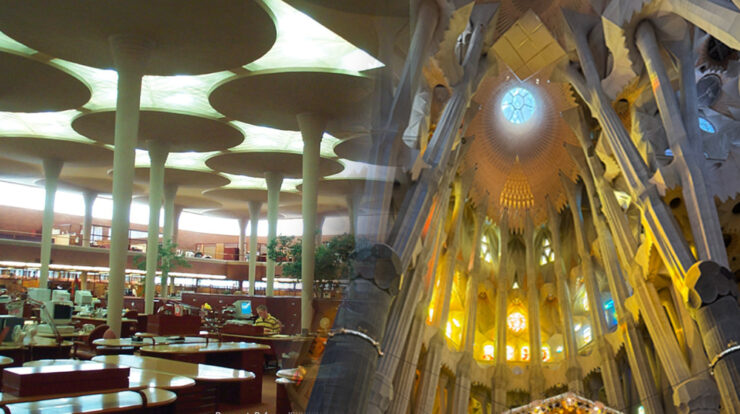
Many folks probably know that I am a huge Frank Lloyd Wright fanboy and have visited several of his buildings around the US. His work continues to inspire generations of designers and contains many examples of biophilic design. I am also a fan of Antoni Gaudí, the Catalan architect from Barcelona. He also designed many fantastical biophilic buildings, several of which I visited last summer in Barcelona. Both Gaudí and Wright created highly biophilic spaces, and their approaches were radically different.
Frank Lloyd Wright
Frank Lloyd Wright (1867–1959), like his mentor Louis Sullivan, was part of the Prairie School aesthetic. Wright’s early works (1890s–1912) are mainly located in the Chicago region and can be characterized as low and long, hugging the earth and reflecting the flat vistas of the Midwestern prairie landscape. The building compositions are mostly rectilinear and constructed of wood, brick, and plaster. Curvilinear biomorphic forms appear in Wright’s later works, like the Guggenheim Museum in New York, but not so much in his early decades.
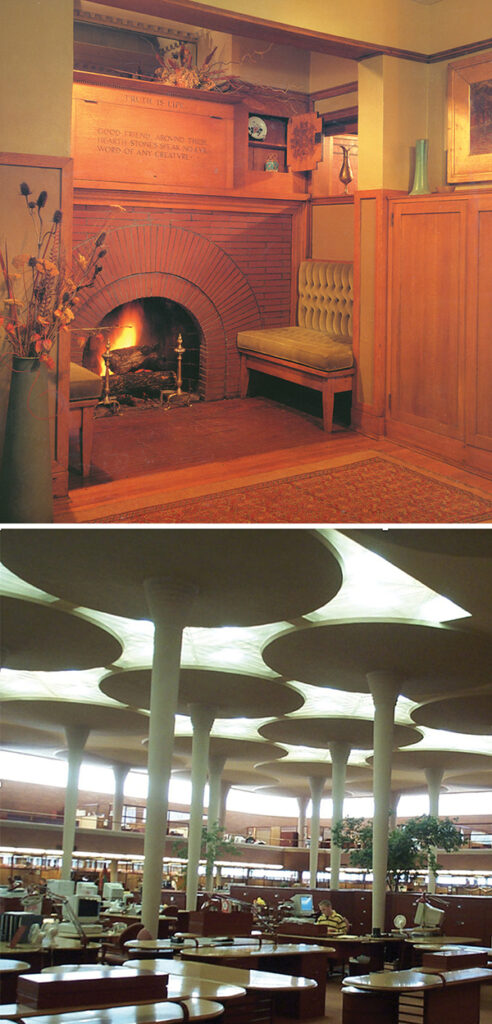
Frank Lloyd Wright interiors with (above) high refuge and moderate prospect of a residential inglenook in Oak Park, IL, and (below) high prospect with moderate refuge at the Johnson Wax Administrative Building in Racine, WI. These biophilic characteristics that are so effective and beloved that they haven’t been altered since FLW designed them.
The colors of his interiors are typically warm and autumnal. The wood, frequently oak, is fumed or stained to highlight the grain and warm golden color. Plaster walls might have a gold, orange or light greenish tint.
Wright used abstractions of local plants and flowers in his stained-glass design and later in the fret work on the wood panels in clerestories and in the patterns of his concrete ‘textile block’ Usonian houses. The stained-glass patterns are frequently linear compositions of metal caming with pops of color. In later fabric and graphic compositions, he continued to use linear or geometric abstractions of nature and more color.
Unlike the distinct individual rooms typical in houses of his time, the rooms in his designs flow from one to another. Corners were opened and outer walls might have windows meeting, which Wright called breaking the box. For example, in the Pope-Leighey house, Wright also used some tricks like breaking the corners of a room with vertical strips of glass and using clerestories around an entire space to brighten the ceiling to make the space appear even larger.
Wright’s buildings have intentional experiential paths. Grant Hildebrand, the late architectural historian, described the spatial experiences in the 36 homes Wright designed over the course of his career. He notes how the spatial patterns of Prospect and Refuge occur frequently and very intentionally in Wright’s houses. Hildebrand points out that you can see where Wright’s head is at by the balance of Prospect and Refuge in any given design. When he was in a good place, the balance is strong, when he was mourning, Refuge dominates.
Wright was clearly using these patterns intuitively though, with all his prolific writing, these spatial experiences are never detailed. What he did describe is a spatial experience that we now call the pattern of Awe. In Wright buildings, big and small, the entrance is frequently obscured and, upon entering, the spaces are low ceilinged and narrow. One moves through the entry sequence into a main space where the ceiling is significantly higher and the room much more expansive—he called this ‘compression and release’. The Pope Leighey house, Robie House, the Guggenheim Museum, and the Johnson Wax Administration Building each possess these characteristics of compression and release.
We recently lost one of the pioneers in biophilic design. Grant Hildebrand (1934–2025) taught architectural history at the University of Washington and had practiced architecture in the offices of Albert Kahn and Minoru Yamasaki. He wrote several books, two of which I highly recommend. The first is The Wright Space, Pattern and Meaning in Frank Lloyd Wright’s Houses (1991) and Origins of Architectural Pleasure (1999). Prof Hildebrand was deeply interested in the work of the English landscape geographer, Jay Appleton, and his definition of the patterns, Prospect and Refuge. He built on Appleton’s work in way that lays the foundation for much of today’s understanding of the spatial aspects of biophilic design.
Antoni Gaudí
Antoni Gaudí i Cornet (1852–1926) was part of the Modernisme movement in Barcelona, the Catalan version of the Art Nouveau, led by architects like polymath Lluís Domènech i Montaner. His beautiful tile encrusted Hospital de Santa Creu complex is now a UNESCO Heritage Site. While Domènech’s interiors have walls and vaulted ceilings covered in tile mosaics that celebrate flowers and nature, they are mostly rectilinear. Gaudí pushed exuberantly further.
Casa Batlló was an existing apartment building that Gaudí morphed and expanded. The exterior went from a standard flat façade to a building layered with biomorphic forms, and interiors with ceilings and walls of swirling plasterwork, curvilinear woodwork, and a lightwell clad with vibrantly colored tile. The front portion of the rooftop is shaped and covered with tiles to represent a dragon, as a reference to St George, the patron saint of Barcelona.
Gaudí did more than just use biomorphic forms for surface decoration and for shaping rooms, he used biomorphic forms as structure. For example, the attics of Casa Batlló and Casa Mila are very much rib cages and the nave of the Sagrada Família is very much supported by a forest of trees. The west façade of Sagrada Família also has structural elements that are based on bones.
Casa Mila, an apartment building that Gaudí designed from scratch, features an exterior wrapped in billowing stonework with iron balcony railings that are abstracted plants. The roof features oddly anthropomorphic chimneys and vents. The doglegged, interconnected atrium courtyards at Casa Mila have curving surfaces of colored plaster that make for an intriguing Mystery condition.
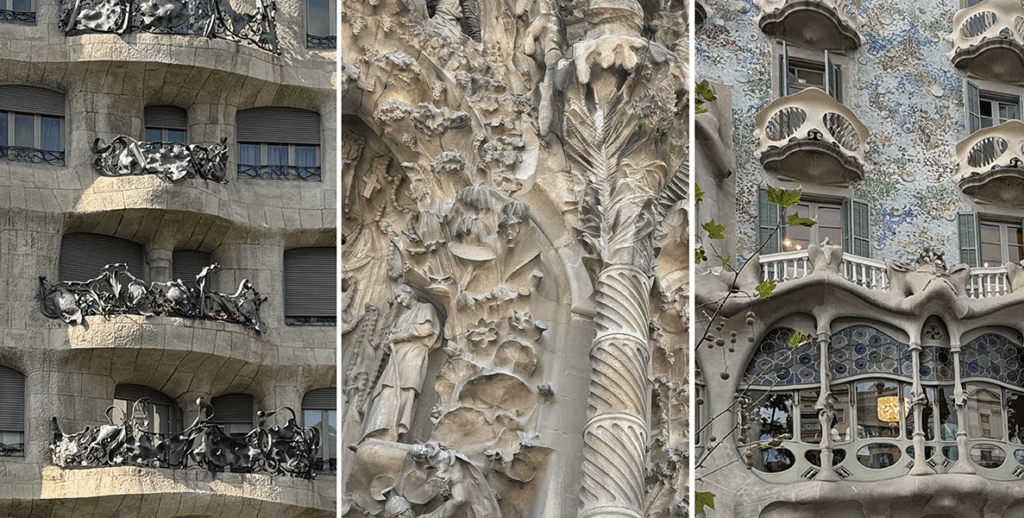
Antoni Gaudí’s building façades with ornate, biomorphic forms: (left) Casa Mila, (center) La Sagrada Família, and (right) Casa Batlló can all be experienced in Barcelona, Spain.
Looking up into the soaring nave of the Sagrada Família is undoubtedly an Awe-inspiring experience. The drama of the branching tree structure is enhanced by Gaudí’s introduction of daylight laterally and vertically in the ceiling of the nave. The compression and release experience that occurs in many grand cathedrals is not entirely evident as one enters from the side of the nave, but once the main entrance and narthex are finally constructed, the true drama of the space will be fully realized.
Wright and Gaudí each used natural analogues and spatial patterns to create extraordinary biophilic buildings, but their radically different strategies were equally effective. This is why I find biophilic design to be such a powerful tool—with very different elements leading to equally effective results—it transcends aesthetics and style to focus on design intent for the building experience.
Topics
- Conference
- inspirational hero
- interior design
- connection with natural materials
- Carbon Strategy
- Transit
- Mass Timber
- Workshop
- Education
- Psychoacoustics
- biophilia
- Environmental Values
- Occupant Comfort
- Publications
- Portuguese
- French
- Hebrew
- Spanish
- Catie Ryan
- Biophilic Design Interactive
- Biomorphic Forms
- PDX
- 14 Patterns
- Dynamic Light
- Mind-Body-Space
- Epigenetics
- Neuroarchitecture
- collaboration
- fractal fluency
- fractals
- Technology
- Refuge
- Prospect
- Antoni Gaudi
- Awe
- Frank Lloyd Wright
- case studies
- wood
- Sustainability
- economics of biophilia
- Green Guidelines
- Master Planning
- Residential
- Biodiversity
- Systems Integration
- Building Performance
- Indoor Environmental Quality
- Health & Wellbeing
- Climate Resiliency
- Profitability
- Architects and Designers
- Ecosystem Science
- Institutional
- Corporations and Institutions
- Water Management
- Energy Utilization
- Resorts & Hospitality
- Net Zero
- Commercial
- Biophilic Design
- Sustainability Plans
- Greenbuild
- Community Development
- Phoebe
- Terrapin Team
- LEED
- Speaking
- Materials Science
- Carbon Neutrality
- Health Care
- Bioinspired Innovation
- Resource Management
- Industrial Ecology
- Manufacturing
- Original Research
- Product Development
- Urban Design
- Governments and NGOs
- Developers and Building Owners